By Jay Benjamin · Theragun G3PRO, received as a Father’s Day gift in June 2024 · Published August 2026
Disclosure: This one was a gift from my family, not from the company. No sponsorship, no comped unit, no relationship with Therabody. I mention it because it matters to how you read the review — nobody sent me this hoping for coverage, and I had every reason to want it to work.
The Verdict, Upfront
Two years on a shelf. More punishment than treat, unless you already know you like deep-tissue work.
- Buy it if you’re a serious athlete who wants deep-tissue work, you’ve used one before and know you like the sensation, and you have a specific chronic problem area you’re treating.
- Skip it if you’re buying it as a general comfort or relaxation tool, you haven’t tried percussive therapy before, or you’re buying it as a gift for someone who hasn’t. Especially then.
It has been sitting on a shelf for about two years.
That’s the review. Everything below is me trying to work out why, because I went into this genuinely enthusiastic and I don’t think the failure was entirely mine.
I wanted a recovery tool. Something comfortable — work on my back, loosen things up after a workout, the sort of thing you reach for while watching television. Every athlete I’d seen talk about these swears by them. That’s a strong signal and I believed it.
What I got was a device I’d describe as more punishment than treat. And I mean that fairly literally: using it does not feel good, it feels like something you endure. I tried it several times. Everyone in the house tried it once, as a novelty. Then it went on the shelf and has not come down since.
A Note on Which Device This Is
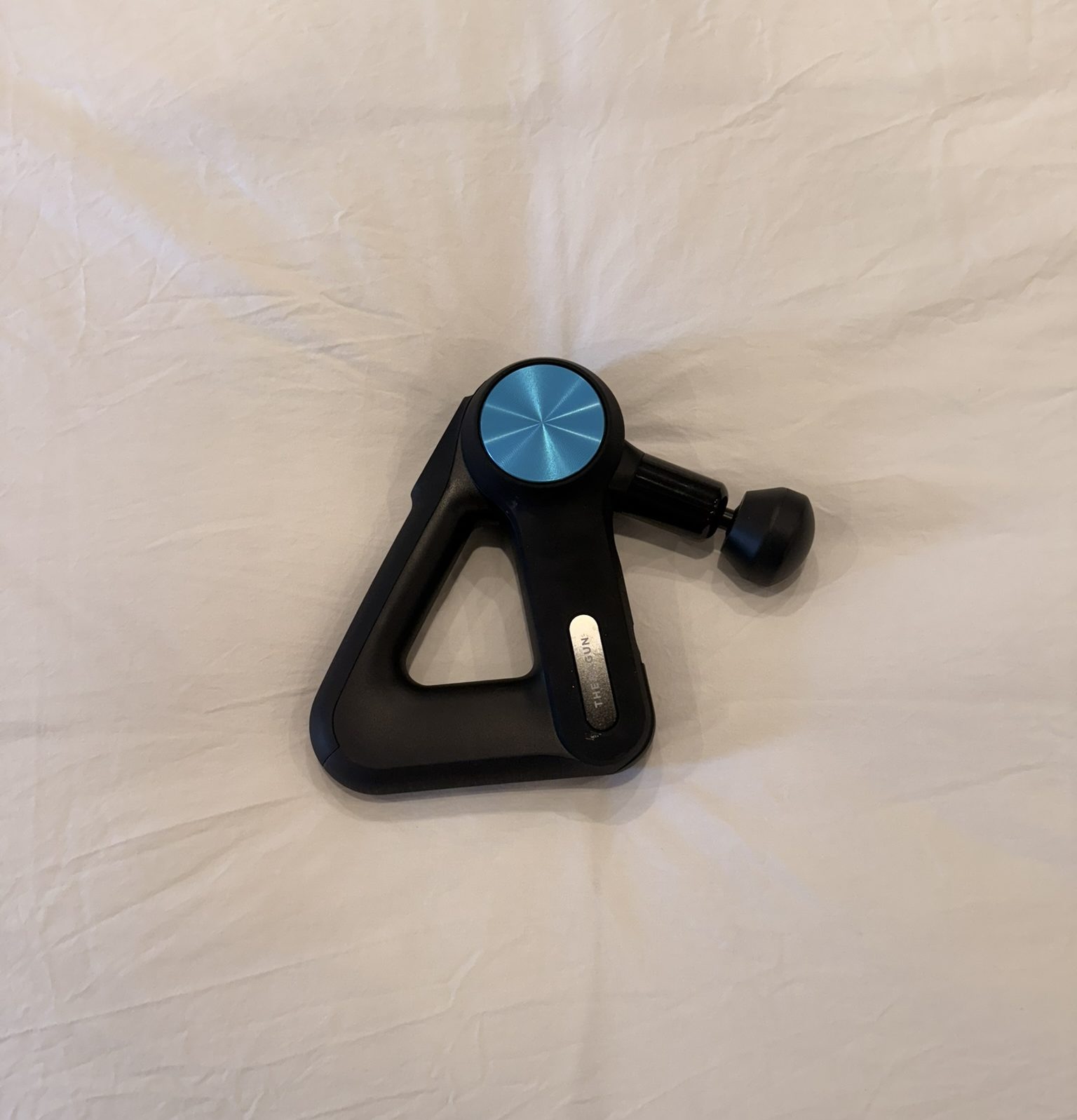
Mine is the G3PRO — the professional flagship from a few generations back. Two treatment speeds, 2400 and 1750 percussions per minute, six attachments, swappable batteries, just over three pounds.
Worth noting that by the time it was given to me in 2024, the G3PRO was already a previous-generation device. That’s not a complaint about the gift — it’s a useful fact for anyone eyeing one secondhand, which is where a lot of these end up.
It also matters because Therabody still sells something called the Theragun PRO, and it is not the same device. The current one offers five speed settings and a different body. If you’re reading this while looking at a product page, that’s more steps than my two — but I haven’t used it, and more steps doesn’t tell you whether the lowest one is any gentler, which is the whole of my complaint. I’ll come back to that, because it changes my advice but not my verdict.
It’s Much Bigger Than You Think
The first surprise, before I’d even switched it on. This thing is large and it is heavy.
Product photography does it no favors. In pictures it reads as a slightly chunky handheld gadget. In your hand it’s closer to a power tool — three-plus pounds, substantial enough that holding it up to reach your own back is a workout in itself. Maneuvering it around your body is genuinely awkward, and the irony of needing recovery from your recovery device is not lost on me.
If you’re buying one, hold it in a shop first. This is the single easiest thing to get wrong from a product page.
Two Settings, Both Too Much
Two speeds. 2400 percussions per minute, or 1750. That’s the entire range.
Both are uncomfortably aggressive. Not intense in a satisfying way — aggressive in the way that makes you grit your teeth and count down. The slower setting is marketed as the lighter option for sensitive areas, and on my body it is still well past the point of pleasant. There is no configuration of this device that produces the loosening sensation I wanted.
This is the core failure, and it’s worth being precise about it: the problem isn’t that the device is too powerful. It’s that the range doesn’t extend downward far enough to include me. A tool whose floor sits above your comfort level is not a tool you will use.
The Attachments Don’t Save It
Six interchangeable heads — different shapes for different muscle groups, each supposedly suited to a particular job.
Two problems. First, swapping them is a hassle, and any friction between you and the thing you’re meant to do daily is fatal. Second, and more damning: I worked through several of them and none produced a comfortable result. Softer heads take a small edge off the impact, but they don’t change the fundamental character of what’s happening, which is a motor driving a hard object into your muscle at a speed you didn’t choose.
The attachments are marketed as the customization story. In practice they’re variations on a sensation I didn’t want in the first place.
The Shelf Test
I’ve come to think this is the only recovery-product review that matters: is it still in the rotation a year later?
My Normatec boots pass. I use them without thinking about it, because sitting still with your legs squeezed is pleasant and requires nothing of you. My Oura ring passes — five years and I still check it every morning. This failed inside a month, and the failure mode was completely predictable in hindsight. Recovery tools have to be nice. If using the thing is unpleasant, no amount of physiological benefit will keep you reaching for it, because you’re tired and sore and you have a choice.

The family novelty phase is telling too. Everyone tried it once. Nobody asked for it again. That’s not a product failing to deliver benefits — that’s a product nobody enjoys.
The Flagship Was the Wrong Choice, and That’s Counterintuitive
Here’s the part I’ve been chewing on. The G3PRO was the top of the range — the most expensive, most powerful device Therabody made at the time, explicitly built for physical therapists, athletic trainers and competitive athletes. It delivers up to sixty pounds of force without stalling.
That is precisely why it failed me. Every attribute that justified the premium — more force, heavier professional-grade body, a speed range calibrated for people who treat athletes for a living — made it worse for a person who wanted a pleasant back massage on a Tuesday evening. I was given the best one, and the best one was wrong.
The current lineup has a direct answer to this. Therabody now splits its range into performance and wellness tiers, and the entry-level Relief sits at the gentle end deliberately: a 10mm stroke against the 16mm on the performance devices, around twenty pounds of force rather than sixty, roughly 1.4 pounds rather than three-plus, one button and three speeds. It lists near $140, against the $599 the G3PRO commanded.
So my guidance is the opposite of the usual advice: buy down, not up. The instinct to get the serious version is backwards unless you already know you enjoy the sensation. The cheap one isn’t a compromised version of the expensive one — it’s a different tool aimed at a different experience, and for most first-time buyers it’s the correct one.
To be clear about what I’m doing here: that’s reasoning from published specifications, not from testing. I haven’t used the Relief. I’m telling you where the numbers point, not reporting an experience.
What It Actually Cost
Nothing, to me — it was a gift, and I don’t have the receipt. For reference, the G3PRO listed at $599 when it was current, making it the most expensive device in Therabody’s range at the time. By 2024 it was a previous-generation device, so I can’t tell you what was actually paid.
For context on the current lineup, published list prices run from roughly $140 for the entry-level Relief to around $650 for the top professional model, with most of the range landing between $220 and $400. Those are retail figures from current listings, not from a receipt of mine.
The real cost here isn’t the money anyway. It’s that a well-intentioned gift became an object that has occupied shelf space for two years while making everyone involved feel vaguely guilty about it. That’s a worse outcome than a bad purchase.
What’s Changed Since I Got It
Quite a lot, and mostly in the direction of my complaint — which I’ll credit them for.
The range has expanded considerably and split into performance and wellness tiers. The current PRO offers five speeds rather than my two. Several models have shed meaningful weight, and there are now compact and heat-equipped options. The two-speed flagship configuration I’m complaining about is genuinely dated.
If your objection to this review is “you’re reviewing an old device,” that’s a fair hit and I’ll take it. But it’s also the review a lot of people need, because these things get gifted, they don’t break, and there are a great many G3PROs sitting in cupboards right now while their owners wonder what’s wrong with them.
The Verdict
A strong no-buy on the G3PRO, and a warning about the category generally.
Percussive massage is a real thing that helps real people, and the athletes praising it aren’t lying. But the sensation is polarizing in a way the marketing completely obscures, and “professional-grade” is a selling point that quietly means “more of a thing you may not enjoy.”
Try one before you buy one. Buy the gentle model, not the serious one. And think twice before giving one as a gift, because you’re not giving somebody a massage — you’re giving them a decision about whether they like being hit repeatedly by a machine.
For the rest of the expensive gear in my house, including what gets used and what sits on a shelf like this one, see my rundown of home and fitness purchases.
It’s not the only well-meant gift that went unused; more of them ended up in the garage.
Frequently Asked Questions
How much does a Theragun cost?
Current list prices run from about $140 for the entry-level Relief to roughly $650 for the top professional model, with most of the range sitting between $220 and $400. Mine is a G3PRO, which listed at $599 when current — it was a gift and I don’t have the receipt, so I’m quoting published retail figures rather than what was actually paid.
Is the Theragun worth it?
Not for me, and mine has sat unused for two years. It’s worth it if you specifically want deep-tissue percussive work and already know you tolerate the sensation. It is not worth it as a general comfort or relaxation purchase, which is what I mistakenly bought into.
Does a Theragun hurt?
Mine is uncomfortable at both of its speeds — 2400 and 1750 percussions per minute — and I’d describe using it as closer to punishment than treatment. Newer models offer finer speed control and the entry-level Relief uses a shorter stroke with roughly a third of the force, so this is partly a model-specific complaint. But nobody warned me the sensation itself might simply not suit me, and that’s the warning I’d have wanted.
Which Theragun model should I buy?
Buy down rather than up. The professional flagship is heavier, more forceful and offers less gentle range — all the things that made mine unusable for me. The Relief at the bottom of the line is lighter, uses a shorter stroke and delivers considerably less force, and I suspect it’s the right device for most people buying their first one.
How many speeds does the Theragun G3PRO have?
Two: 2400 and 1750 percussions per minute. Note that the current Theragun PRO shares the name but not the specification — it offers five speed settings. If you’re comparing a secondhand G3PRO against a new PRO, that’s a meaningful difference.
Is it heavy?
The G3PRO is just over three pounds, and it feels it. Holding it overhead to reach your own back and shoulders is tiring, and moving it around your body is awkward. Hold one in person before buying — product photos badly understate the size.