By Jay Benjamin · Traveled March–April 2026 (Morocco) and July 2026 (Mexico) · Published August 2026
Disclosure: I paid full rate for both trips. No hosted stays, no comped excursions, no press rates, and no commercial arrangement of any kind with Black Tomato or with any hotel named here. All figures below come from my own invoices and card statements.
The Verdict, Upfront
Four months apart, I took two trips. The first I handed to Black Tomato, a high-end travel agency, and then mostly stopped thinking about until we landed. The second I planned myself, using AI for the work I’d previously outsourced.
Morocco came to roughly $36,100 for four people over seven nights, not counting airfare. Mexico came to $10,471 for two people over four nights. Those look like different universes until you divide: about $1,290 per person per night in Morocco, and about $1,310 in Mexico.
The agency was not the expensive option. If anything, the trip I planned myself came in slightly higher.
That reframes the entire question. If you’re not paying a premium for the agency, what exactly is the agency for?
Three things, sold as one. Curation — deciding where you go and what you do there. Execution — the guides, the drivers, the reservations, the person waiting at the airport. And absorption — carrying the risk that any of it goes wrong.
I assumed AI would take the first and I’d be stuck doing the second. What actually happened is that a very good hotel took both, and did the curation better than my AI did. Nothing took the third, and the third is the one I noticed.
| Morocco | Mexico | |
|---|---|---|
| Planned by | Black Tomato | Me, with AI and a hotel concierge |
| Dates | March–April 2026 | July 2026 |
| Travelers | Two adults, two kids (14 and 11) | Two adults |
| Nights | 7 | 4 |
| Cost, excluding airfare | ~$36,100 | $10,471 |
| Per person, per night | ~$1,290 | ~$1,310 |
| Hotels | Villa des Orangers, Caravan by Habitas, Kasbah Tamadot | Casa Polanco, Rosewood San Miguel de Allende |
| Anything go wrong? | One promised surprise never arrived | Nothing |
Morocco: I Diagnosed the Problem in November and Declined the Fix
The most valuable thing the agency did was put a person at every seam. Someone met us at the airport. Someone met us at the hotel. Someone was there at every handoff from driver to guide and back again. Moving four people through a country where I speak none of the language, that continuity isn’t a flourish. It’s the product.
They don’t book flights, so we did that ourselves. Los Angeles to Paris in business class, which my children enjoyed enormously and about which I have complicated feelings I won’t pretend to have resolved. The connecting leg to Marrakech was also sold as business class. On that route, business class means the middle seat is empty. That is not a cabin. That is a coincidence.
Now the part that’s harder to write.
In mid-November, more than four months before departure, I emailed our trip designer unprompted to say I was nervous about the Marrakech hotel and wondered whether something larger and better suited to families made more sense. I named four alternatives by name: Royal Mansour, La Mamounia, Mandarin Oriental, Four Seasons.
She priced two of them. A private villa with its own pool and a butler at Royal Mansour was a $17,000 supplement for the four nights. A two-bedroom panoramic suite at the Mandarin Oriental was $13,900. In early January, I declined both and left the booking as it stood.
So this is not a story about an agency recommending the wrong hotel. It’s a story about a man who correctly identified the problem, was quoted the price of solving it, decided it wasn’t worth the money, and then spent four days discovering that it was. Which is a different genre of article entirely, and a more useful one.
What Was Actually Wrong With It
Villa des Orangers is, objectively, a lovely hotel. Inside the old city walls, walking distance to everything, small and beautifully run. Every claim made for it was true. I’ve written a full review of it here.
It is also quiet in the way a good library is quiet, romantic in register, and populated mostly by older European couples who had come for exactly that. Then my children got in the pool. We were, for four days, the incident.
The room compounded it. A two-bedroom suite that sleeps four is, on paper, exactly right, and the layout itself was fine. What wasn’t fine was that every window faced the interior courtyard and none faced out. There’s centuries of architectural logic behind that design and I don’t dispute any of it. I still spent four days unable to tell what the weather was doing.
I did hear a consistent note about Royal Mansour, the most exclusive property in town — that it’s so rarefied you can end up feeling like the only guest in the building, which more than one traveler described as faintly lonely with children in tow. With the kids along, I’m glad we skipped it. The Mandarin Oriental, with a pool nobody minds kids using and room to spread out, I think about regularly.
A Note on the Children
Morocco wasn’t their idea. It was barely ours — a friend had gone, loved it, and moved it up our list. When we told the kids we were going to Africa, they pictured animals. What arrived was a city of extraordinary sensory density: heat, dust, unfamiliar food, an unfamiliar alphabet, and a main square containing live cobras.
I loved the snake charmers in Jemaa el-Fnaa. Standing there felt like walking into a cartoon I’d watched as a child, except the cobra was real and it was looking at me. My daughter did not love this. My daughter would like it noted that she did not love this.
I don’t think they ever fully closed the gap between what they expected and what they got, and the hotel concentrated that rather than relieving it. A pool they were allowed to shout in would have solved more than I understood at the time.
The Excursions, and the Pattern They Revealed
A clean pattern emerged. The excursions that worked had young, energetic guides and delivered us somewhere we could not have reached alone. The ones that didn’t were competent, generic, and available to anyone.
The vintage sidecar tour was the best thing we did. Three people per bike, drivers in their twenties who talked to my kids like people, and routes through passages too narrow for a car and too long to walk. It finishes at Dar El Sadaka, an estate outside the city belonging to the French artist Jean-François Fourtou, where oversized surreal works sit out in the grounds and you’re allowed to climb on them — including a house built upside down that you can pretend to push over.

I want to be precise about that stop, because it’s the strongest argument in this article. There was no ticket booth, no admissions desk, and as far as I could tell nobody else on the property. It is not a museum you can decide to visit on a Tuesday. Access was arranged, by someone, somehow, and I never learned how. That’s what you’re actually buying. Not speed of research — you can do research. Doors that aren’t open.
The cooking workshop was the other hit. We do a cooking class in most cities and they’re reliably good with children. This one earned it: after cooking, we carried our tray of cookies through the streets to the neighborhood’s communal wood-fired oven — the one locals use for daily bread — and baked them there. My kids did not develop a taste for tagine. They will remember the oven.

The half-day medina walking tour was better than I expected. The medina is the reason to come to Marrakech — a working labyrinth where the century is genuinely in question — and it’s far larger than it looks from outside. A guide is worth it here, not for the history but for the orientation, because the place is not navigable on instinct.

One small thing the guide gave us that I’d have missed entirely: the pyramids of brightly colored spice powder you see stacked in the souks are, he said, largely staged for photographs and tourists rather than sold that way to locals. It’s a harmless bit of theater. But it’s a fair illustration of how much of what you’re looking at, you can’t correctly read on your own.

The evening street food tour was a pass, and I now think the fault was scheduling rather than the tour. It ran the same day as the walking tour, through the same maze. We’d done a spectacular food tour in Thailand so the bar was high, and this one ran to heavier seated portions with a guide working through a script. But the real problem is that your first impression of the medina is a resource you get to spend exactly once, and our itinerary spent it twice before dinner.
The perfume atelier was a novelty. I’d assumed a tour with some history attached. It’s ninety minutes to two hours seated with a hundred scent bottles, building a custom blend. The woman running it was lovely. My nose quit somewhere around bottle sixty. Interesting once; I wouldn’t send anyone.
The Majorelle garden and the YSL museum were both passes, which I offer knowing they are the two things every list tells you to do in Marrakech. The garden was pleasant and no more than that. The museum held none of us. Neither captivated the children for a minute, and between them they consumed a slot we’d have spent better almost anywhere else. If you’re traveling with kids and someone has put both on your itinerary, consider cutting at least one.
The Desert Was Not the Desert I Was Promised
One night at a tented camp in the Agafay, which used to be rare and now isn’t — there are dozens of these camps out there, and the scarcity that made them special is gone. The Agafay is rocky rather than sandy, and it had rained for the first time in roughly four years, so it was faintly green. My children had come for dunes. They got a meadow.

The buggies were genuinely fun. The camel ride produced the quietest and most telling moment of the trip: our guide, in traditional dress, asked for my phone and then executed a slow, practiced camera move he had clearly performed several thousand times, framed precisely for the platform I was going to post it on. He was considerably better at this than I was.

Dinner ran very long — a real problem when you have one night — and we gave up and went to bed. We’d been told there would be a surprise that evening. It never came, and nobody told us it was still on its way.
To their credit, and this counts: the agency apologized without being chased and covered a dinner for us later in the trip. That’s what service recovery is supposed to look like and most companies never manage it. But the surprise is the thing they’re known for, and the other one we did receive — a Polaroid camera brought along on the sidecar ride, with some film — was modest. Across a trip this size, the signature flourish went one for two.
One other note, offered as information rather than grievance: the final-payment email in early March had considerably more urgency in it than anything that came before, including a warning that reservations were at risk. The money was owed and I paid it the same day. It just sat oddly against the invitation, four months earlier, to sit back and let them handle everything.
Kasbah Tamadot: I Overruled the Agency and the Agency Was Right
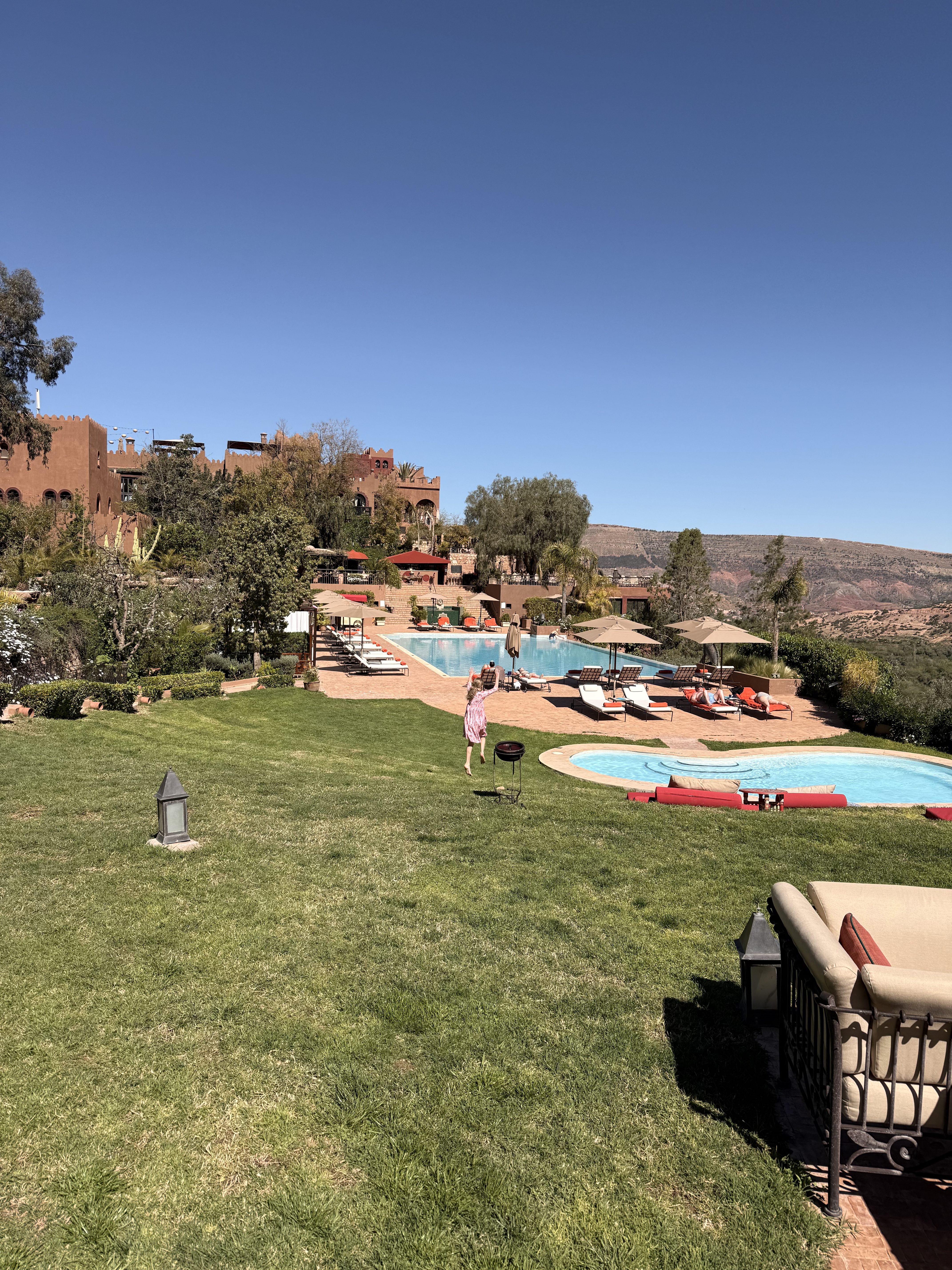
Kasbah Tamadot, in the Atlas Mountains, is Richard Branson’s, and it was the best hotel of the trip by a wide margin. An oasis at altitude, food and drink well beyond what the setting demands, grounds worth the drive on their own.

Here’s what I told people afterward: that Black Tomato couldn’t get us in. That is not what happened. They had us booked at a different mountain property. I found availability at Tamadot myself, across two separate room categories, and pushed to switch.
Our trip designer warned me. Twice, in writing. She explained that the freestanding tented suite sits roughly a ten-minute walk from the main building, across open gardens and the pool area, and said plainly that she wouldn’t be comfortable with our children that far from us. She wrote that Tamadot was the more luxurious property and the less comfortable layout for a family of four. She even sent a floor plan.
I went anyway. And the thing I complained about afterward — a family split across two buildings and two room classes — is exactly the thing she described in advance, on a floor plan, in February.
She was also right about the food. She recommended half board because dining options up there are essentially nonexistent and the à la carte menu is expensive. I declined that too, on the grounds that it was confusing and I didn’t want to sort it out.
Separately, the tented suite had a persistent bad smell and we moved rooms for the final night. And the property’s larger standalone family accommodations, which photographed poorly online and which I therefore skipped, turned out in person to be the best rooms there — at roughly what my two separate rooms cost. That’s twice in one week I trusted a photograph over a phone call.
The highlight there was a visit to the workshops supported by the Branson family’s local foundation, where the rugs and fittings used throughout the hotel are made. Genuinely behind the scenes, and you can buy directly. We bought too much and they shipped it home. Whether it was a good price I honestly can’t tell you. It felt like money going somewhere useful, and I’m aware that a feeling is not evidence.
So Was Morocco Worth It?
I’ve spent several thousand words on how this trip was arranged, so I owe you the simpler question underneath it.
Morocco was interesting and I’m glad I went. It is not a recommendation, and I have no plans to return.
The medina is extraordinary — for a while. The people were warm and the culture is rich and genuinely rewarding to spend time inside. The Atlas Mountains earned every hour. But “extraordinary for a while” is the honest ceiling, and the thing that makes the place remarkable is the same thing that wears you down: the intensity never lets up, and by the end of a week we were done.
I’m aware this cuts against the current. Morocco is having a long moment. Celebrities have houses there, the magazines love it, and Marrakech has become somewhere a certain kind of traveler is expected to have been. None of that is wrong. It just doesn’t add up, for me, to a place worth a second week of a finite life when the list of places I haven’t seen is as long as it is.
The one return trip I’d consider is two nights at the Royal Mansour as a stopover en route somewhere else, without children — which is the same hotel I priced, declined, and dismissed earlier in this article as too rarefied for a family. It was never the wrong hotel. It was the wrong hotel for the trip I was taking.
And to be clear about the length: I wouldn’t reallocate that surplus Marrakech night anywhere. Not to the desert, which we’d exhausted in an evening, and not to the mountains — Kasbah Tamadot was the most comfortable place we stayed and I’d happily have had another day there, but we’d done everything there was to do in the time we had. The right correction isn’t to move the night. It’s to take a six-night trip instead of a seven-night one and go home.
Go knowing what it is and it’s a fine trip. Go expecting to fall in love and you may find, as I did, that you admired it more than you enjoyed it.
Mexico: The Hotel Became the Agency
Here’s the difference nobody warns you about. When I told Black Tomato I wanted to go to Morocco, they came back with an itinerary and a few options. When I told AI I wanted to plan an anniversary trip, it came back with the planet.
Bora Bora. Paris. Everywhere. Narrowing that took days of genuine back-and-forth about what we actually wanted — work an agency simply absorbs. San Miguel de Allende surfaced because it kept appearing on serious lists, because it was close to home, because we could route through Mexico City for a dinner we’d wanted for years, and because it had the specific appeal of a place people had heard of but nobody we knew had actually visited.
Then AI did something an agency arguably wouldn’t have. I asked for hotels near that dinner in Mexico City. I’d stayed at the Four Seasons before and hadn’t loved it. It suggested Casa Polanco, which I’d never heard of, and which turned out to be one of the best hotels I’ve stayed in anywhere. That’s a real find and I would not have made it alone.
It proposed the pyramids. It helped pick a specific room category at the Rosewood.
And then it stopped, because AI cannot make a phone call — and, it turns out, because AI doesn’t know what’s actually there.
The Correction That Justified the Whole Concierge Desk
My plan for San Miguel included a private mezcal palenque visit — production and tasting.
There is no mezcal production in San Miguel de Allende.
Deborah, the concierge, told me so directly, and then told me what was true instead: that a town called San Luis de la Paz, a bit over an hour away, does produce mezcal and sits inside the official denomination of origin, and that she’d be glad to arrange the trip. In the end we stayed closer to home and drank very good mezcal in town, which was the right call for a four-night trip. But the correction is the point.
That’s not execution. That’s curation — and it caught a factual error that my AI-assisted plan had produced and that I had no way to detect on my own.
It wasn’t the only one. She flagged that the archaeological site I wanted had closed, then tracked its reopening and told me the moment it was visitable again. She noticed that I’d booked the hotel’s restaurant on the one night of the week it serves a burger-only menu, which is the sort of thing you find out at the table otherwise. She suggested an artisan workshop tour I hadn’t known existed, and a rooftop cocktail at sunset before our anniversary dinner. Her colleague Montserrat, hearing I wanted an unscripted walking tour rather than a fixed route, said she’d find a young, high-energy guide who could improvise — which is exactly what made the Morocco excursions work, arrived at independently by someone who’d never met me.
Everything downstream got handled the same way: guides, the archaeologist add-on at the pyramid site, intercity transport, restaurant bookings, a specific high-floor suite request confirmed before arrival. All of it charged to the room. One bill, one point of contact, no agency.
One concrete data point on why it’s worth asking more than one party for the same thing: the car from Mexico City to San Miguel was quoted by one hotel at MXN 18,635 and by the other at MXN 13,375 — about 39% apart for the same drive. In fairness, the more expensive quote came with a note that a fluent English-speaking driver generally requires a higher vehicle class. Still worth the email.
Guanajuato, Which I Nearly Missed
Our only nonstop home left León at 8:28 p.m., which left an entire final day to fill. The concierge built it around Guanajuato, and it was the highlight of the trip.
The city is stacked vertically into a hillside in a way photographs genuinely cannot convey — buildings piled on buildings, houses with no road access where people carry groceries up on foot, and a network of one-way tunnels left from the mining era that you drive through and emerge from in the town square. There’s hard history there, displayed publicly and without softening. It felt like a place Mexican tourists go and Americans mostly don’t: no flagship hotels, no international brands. I’m not sure I’d want to sleep there. I wouldn’t have missed it for anything.
Mexico City: I Ignored the One Person Who Told Me the Truth
Before San Miguel, we spent a night in Mexico City for a dinner I’d wanted for years: Pujol. It’s one of the most famous restaurants in the world, it’s been at it a long time, and I planned an entire stop around it. A Mexican friend who had actually eaten there told me to go somewhere else. I ignored him, because I was in love with the name.
We took the taco omakase at the counter rather than the regular tasting menu, on the theory that the more unusual format would be the better experience. It runs a fixed price of around MXN 4,400 a head, so with a couple of cocktails, dinner for two came to roughly $450.
The mole madre is genuinely worth experiencing once. It’s aged for years, it’s the dish the place is known for, and I’m glad I tasted it knowingly rather than reading about it. But several of the courses were strange rather than good. Two of them involved ant eggs, which my wife did not warm to, and one was a fish taco I can’t now reconstruct, which tells you how much of an impression it made. The meal never found a rhythm.
Then, at the very end, they walked the entire counter across the restaurant to a separate bar in a beautiful indoor-outdoor space and served dessert there. I assumed we were being moved somewhere more intimate. Instead it was cold, and it turned out we’d been relocated essentially to have dessert, settle the bill, and leave. Why move everyone to a different room to pay and go? I still don’t know.
I’m very glad I went. I would not go back, and I wouldn’t recommend it. In fairness to the restaurant, this is not the kind of food I gravitate to anyway. I’m a hearty, savory, Italian-steakhouse-and-chophouse person, and a long parade of the surprising and the delicate was never going to be my ideal night. But that’s exactly what my friend was trying to tell me, and I overruled him because a name had a hold on me. Which, by my count, is the third time in this article I overruled someone who was right.
The hotel is the twist. Casa Polanco was almost an afterthought, chosen only because it was near the restaurant. It turned out to be the best part of the city and one of the best hotels I’ve stayed in anywhere. That one I would go back to, and recommend without hesitation. The thing I planned the trip around disappointed me; the thing I barely thought about carried it.
The One Thing I Couldn’t Replace
Nothing broke in Mexico. No missed transfer, no bad room, no reservation that evaporated. By the only test that matters, the self-planned trip performed perfectly.
And I was braced the entire time.
Not because anything was going wrong, but because if it had, it would have been mine. I hedged to my wife the whole way — I don’t know if this hotel is any good, I don’t know if this town will work, I don’t know about this drive. I was managing expectations downward for a trip that turned out to be excellent.
With an agency I’d have felt some of that too. But I’d have had somewhere to put it. That’s the third product, the one that never appears in the brochure and can’t be unbundled: somebody else holding the responsibility. You’re not buying competence. You’re buying permission to be a guest on your own vacation.
The Third Option Nobody Mentions: Your Credit Card
Part of what an agency sells is supplier relationships — the upgrades and credits that come from being a partner rather than a walk-in. You can buy a version of that annually instead of per-trip.
The Rosewood was booked on an Amex Fine Hotels + Resorts rate. It came with early check-in, a room upgrade subject to availability, daily breakfast for two, a $100 property credit, and a guaranteed 4 p.m. checkout. That’s a meaningful chunk of the same benefit stack, obtained by booking through a card portal I already pay for.
My own caveat, having tested it: it’s competitive on hotels and it is not competitive on flights. I book those separately and so should you.
When to Hire an Agent, and When to Skip It
Two variables decide it. How legible is the destination — can you read it on instinct, is the infrastructure built for someone like you? And what are the stakes — who’s traveling with you, and how bad is it if a day collapses?
Skip the agent when:
- The destination has mature tourist infrastructure — most of Europe, most of Mexico, anywhere you can navigate on instinct
- You’re booking a hotel at a tier where the concierge is genuinely capable. This is the big one, and it’s the finding I didn’t expect: a great concierge does the curation and the execution, and you’ve already paid for it
- You’re traveling as adults, where a day going sideways is an anecdote rather than a crisis
- You’re willing to spend real hours narrowing, because AI hands you the whole world and no opinion about it
Hire the agent when:
- The destination is genuinely hard to read — unfamiliar language and alphabet, thin or unreliable information online. Morocco qualified. Most of Africa would, for me. So would much of Asia, where long flights and heavy jet lag compound every decision
- You have no idea how to fill the days and the wrong answer costs you the trip
- You’re traveling with children, which raises the price of every unforced error
- You’re moving between multiple properties and cities, because the seams are where things break
- You want access to places that don’t sell tickets — the single clearest thing an agency delivered on this trip
Morocco sat squarely in the second column. San Miguel sat in the first — and it helped enormously that the kids weren’t with us. We could improvise, book two spa days, and change our minds without consequence.
What I’d Do Differently
Pay the supplement when I’ve already identified the problem. I flagged the Marrakech hotel four months out, named the alternatives myself, got a price, and declined. The $13,900 would have bought a materially better week for four people. I optimized the wrong variable and I had every piece of information required not to.
Take the warning seriously when the expert writes it down twice. The room-layout problem at Tamadot was described to me in advance, in detail, with a floor plan. I overrode it because I wanted the better hotel, and then experienced precisely the downside I’d been warned about. If you’re paying for expertise, the expensive part isn’t the itinerary. It’s the moment someone tells you no.
Make it a shorter trip. The medina is the reason to go and it is also relentless — heat, noise, density, negotiation, all of it constant. It was the most interesting thing we did and it accumulated into real exhaustion by the end. Four nights in Marrakech was one too many. And I wouldn’t move that night elsewhere: the desert was done in an evening, and while Kasbah Tamadot was the most comfortable place we stayed, we’d exhausted it too. Six nights, not seven, and go home.
Don’t stack two versions of the same experience on one day. A medina walking tour in the morning and a medina food tour that evening is one medina too many. Your first impression of a place is spendable exactly once.
Call the hotel instead of trusting the photographs. Same mistake, twice, in one week, in two countries — and both times the better room was available at a price I’d have happily paid.
Email the concierge before hiring anyone. Six weeks before arrival, with an open-ended question about what’s actually worth doing. That single habit did more for the Mexico trip than any other decision I made.
Ask what the surprises are. Not to spoil them, but because “a surprise” is doing real work in the pricing, and one of ours simply never happened.
Listen to the person who has actually been. One friend told me to skip the restaurant I’d built a city stop around. He had eaten there. I had not. I went anyway.
FAQ
Is a luxury travel agent like Black Tomato worth the money?
It depends far less on budget than on destination. In my case the per-night cost of the agency-planned trip was essentially identical to the self-planned one at the same tier, so the agency isn’t primarily a price premium. It earns its place when the destination is hard to navigate, when you’re traveling with children, when you’re moving between several properties, or when you want access to places that don’t sell tickets. It’s harder to justify in a familiar country, or when you’re staying somewhere whose concierge can do the same work.
How much does Black Tomato cost?
Our Morocco itinerary — seven nights, four people, two hotels booked through them, roughly ten guided excursions and all ground transport — came to about $30,000 in March 2026, with a third hotel booked directly for about $6,100 on top. That excludes international airfare, which they don’t book. Pricing is bespoke per itinerary, so treat this as one data point rather than a rate card.
Does a travel agency itemize what each hotel cost?
Mine didn’t. The itinerary was quoted and invoiced as a single bundled price covering hotels, guides, excursions, and ground transport, with no per-property breakdown. That’s standard practice and it isn’t sinister, but it’s worth understanding going in: you can’t evaluate what any individual hotel cost you, which makes it hard to judge afterward whether a given property was worth its share. If that matters to you, ask for a line-item breakdown before you sign.
Can AI replace a travel agent?
It replaces the research and shortlisting well, and it surfaced a hotel I’d never have found on my own. It cannot make bookings, cannot fix a problem in progress, and cannot take responsibility when something fails. It also can’t get you into a private estate that doesn’t sell tickets. And it doesn’t reliably know what’s physically in a place — my plan included an activity that doesn’t exist in the town I’d planned it for, and a human caught it. On this trip the hotel filled most of those gaps. Without a hotel capable of that, they’d have been much more exposed.
Is Morocco worth visiting?
Once, and with clear expectations. The medina in Marrakech is remarkable, the people are warm, and the Atlas Mountains are worth the drive. It is also relentlessly intense in a way that accumulates over a week, particularly with children, and I finished the trip admiring the place more than enjoying it. I’m glad I went and I have no plans to go back. If you want a destination you’ll fall in love with and return to, I’d look elsewhere; if you want somewhere genuinely unlike home for a week, it delivers that completely.
How many days do you need in Marrakech?
Three nights, in my view, and we did four. The medina is genuinely extraordinary and it is also exhausting — heat, crowds, density, and constant negotiation. It’s the best thing about the city and it wears you down faster than you expect, especially with children. I wouldn’t spend the spare night elsewhere in Morocco either; I’d simply make the whole trip a night shorter.
What’s the biggest downside of planning a luxury trip yourself?
The blank page and the anxiety. AI offers you every destination on earth with no opinion about which is right for you, and narrowing that takes real hours. Then, once you’ve built it, you own every outcome. Nothing went wrong on my self-planned trip and I still spent it braced for something to.
Do luxury hotels arrange tours and transfers for you?
The good ones do, and it’s largely included in what you’re already paying. The Rosewood in San Miguel arranged guides, a private archaeological visit, intercity transport, and restaurant bookings, corrected two factual errors in my plan, and quoted the intercity car about 39% below the other hotel’s price. If you’re staying somewhere at that tier, email the concierge well before arrival and ask an open question.