By Jay Benjamin · Stayed September 2024 · Published August 2026 · Rates and program re-verified August 2026
Disclosure: I paid full rate for this stay. No compensation, discount, or press access was received from the lodge.
The Verdict, Upfront
About $4,750 CAD a night to sleep in a tent, and annoyingly, worth it. Genuinely off the grid, with five-star service underneath.
Worth it if: you want to be genuinely off the grid, with five-star service underneath it. There’s no road in, no way out except by boat or seaplane, limited cell service, and no other restaurant or store within reach, so the lodge is your whole world for the stay. You also have to be comfortable being the kind of person who pays luxury-hotel rates to be slightly cold and occasionally without WiFi, on purpose.
Skip it if: you want swim-up pools, guaranteed connectivity, or a vacation that doesn’t require a seaplane, a boat, and possibly a horse-drawn wagon just to check in.
Clayoquot Wilderness Lodge costs about $4,750 CAD a night for two, all-inclusive, based on what we paid in September 2024. It’s a luxury glamping resort in the Clayoquot Sound UNESCO biosphere on Vancouver Island, which means that money buys you a tent — and I understand exactly how that sentence sounds. It was also worth it, which is an annoying thing to have to admit about a very expensive tent.
| Detail | What to know |
|---|---|
| Rate we paid (Sept 2024) | About $4,750 CAD a night for two, Waterfront Ensuite Tent. The helicopter excursion isn’t covered by the all-inclusive rate; it was charged on top and is likely rolled into that figure. The lodge does not publish rates. |
| What’s included | All activities, all meals, most beverages, one spa treatment per guest |
| Season | Late May to late September |
| Getting there | Seaplane from Vancouver, about 45 minutes to the lodge’s dock, or boat from Tofino; no road access |
| Connectivity | WiFi in-tent only; limited cell service, none elsewhere on property |
| Best for | Couples and small groups who want to be genuinely off the grid, with nothing else around but the lodge |
| Not ideal for | Anyone needing constant connectivity, poolside lounging, or a low-effort arrival |
Getting There Is Its Own Adventure (and a Filter)
There’s no road to Clayoquot. You’re more likely to see a bear than an Uber anywhere near this place, and that’s evidently the point.
Our route from Los Angeles ran nearly 20 hours and stacked commercial flights, a seaplane, a boat, and a horse-drawn wagon. Other guests arrived by private helicopter, which is apparently just a normal option here, the way some hotels have a normal option to request extra pillows.
I spent a meaningful portion of the journey to this UNESCO biosphere reserve in a Vancouver airport food court, eating a sandwich I would describe as structurally sound. Six hours. A trip like this is maybe fifteen percent helicopter and eighty-five percent logistics, and nobody selling you the fifteen percent is going to mention that.
Practical tip: we were told to check in for our seaplane by 2 p.m., which pushed us onto a 6 a.m. departure out of LAX and that layover. In practice the deadline carried roughly the authority of a suggested arrival time on a wedding invitation — our seaplane left later with no issue, and a mid-morning flight would have worked fine. Ask what the actual departure window looks like on your date before you build an itinerary around the stated cutoff.
Pack for it: your bags will be handled four times, by you, personally. A soft-sided duffel beats a hard-shell suitcase. (Full packing list below.)
Check-In: Champagne, a Wagon, and an Itinerary Built Around You

Seaplanes land at a private dock, where General Manager Sarah Cruse greeted arrivals mid-conversation, like she already knew us. The operation ran tightly enough that this didn’t feel like a performance.
From the dock, two horses named Maverick and Goose pull a wagon toward the lodge. Staff meet the wagon with champagne.
I drank the champagne. I did not ask a single question about the horses.
Check-in happens at the Outpost, where staff handed over a three-day itinerary already built around preferences we’d shared by email — physically active, into hiking, not into cold-water swimming. Every hotel sends that questionnaire. This is the first one that appeared to have opened it.
Every activity is included in the nightly rate, so there’s no cost anxiety around swapping or skipping something. It’s the closest adult life comes to being nine years old at a friend’s house for dinner, where the food arrives and nobody discusses what it cost. I hadn’t expected to notice its absence. I noticed it constantly.
The Tents: Camping in the Loosest Possible Sense of the Word
Our Waterfront Ensuite tent had a king bed, heated bathroom floors, and a Bemboka blanket that made the word “tent” feel like it was doing a lot of unearned work in the brochure. The ensuite option skips the walk to a shared outdoor bathroom that cheaper tent categories require. Apparently I now have a whole genre of expensive tents, and my favorite is still the hot-spring-fed tent at Nayara in Costa Rica.

Neighboring tents are visible but spaced for real privacy. We tested this once, accidentally, on a neighbor in a robe. Everyone was gracious about it.
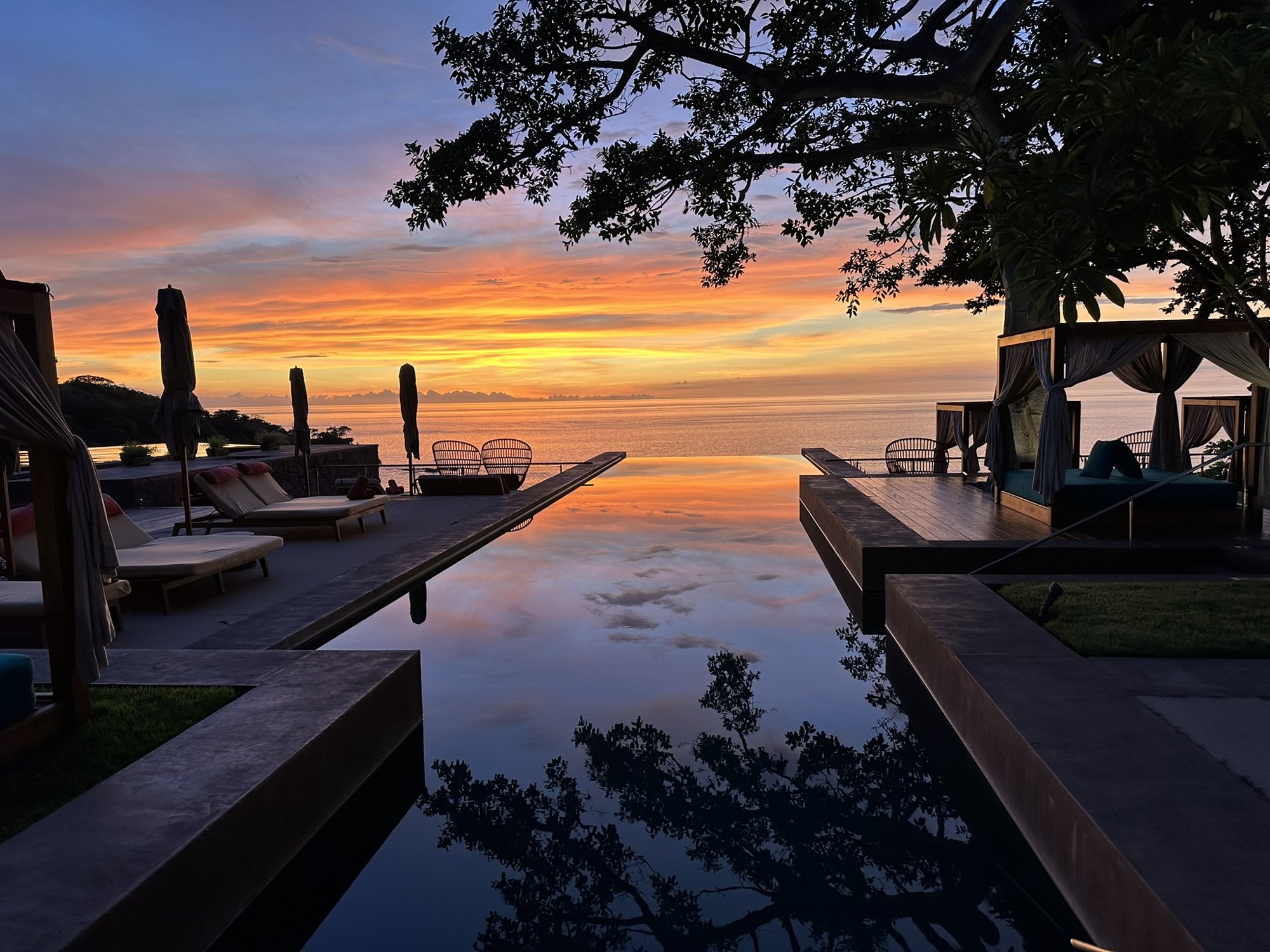
Outside, a private deck looks over the Bedwell River, where the tide swings enough to change the view by the hour. A large rock — referred to, in the lodge’s materials, as the privacy rock — blocks sightlines from the path. It is a rock. It is also better at its job than the curtains in most city hotels I’ve paid comparable money for.
A couple of Adirondack chairs make it a legitimate spot to sit and do nothing. WiFi only worked inside the tent, nowhere else on property. Mildly annoying in the moment, and probably the whole point. I checked my phone anyway, on a deck, in a biosphere reserve.
Food and Drink: The Most Undersold Part of the Stay
I had quietly written off the food before we landed. Remote lodge, captive guests, all-inclusive pricing — I’d filed it under “fine, considering,” which is the polite way of expecting mediocrity. I was wrong in a way I’d like to be wrong more often.
Dinner at The Cookhouse was one of the best meals of the trip, and I mean that against a high bar rather than a wilderness-adjusted one. Expect a rotating nightly menu — scallops, octopus, vegetable risotto, prawns — alongside a strong breakfast and lunch program.

The Ivanhoe Bar, the property’s newest building, has floor-to-ceiling windows over Clayoquot Sound, a fireplace, and a cocktail program built on local ingredients — elderflower, wild blackberries, Canadian maple syrup — instead of the usual resort-cocktail clichés. We watched wild salmon leaping upriver while working through the menu, which is a sentence I did not expect to write about a hotel bar.
Then there was the belt.
Mid-dinner, I realized I had not packed one, and I had a six-hour hike in the morning. I raised this with the tone one would use to report a medical issue. Our waitress produced a belt before dessert arrived. No idea from where. No judgment, either, which I appreciated more than the belt.
I’ve stayed at plenty of hotels calling themselves luxury that couldn’t produce a working iron on 24 hours’ notice. This one produced a belt, on demand, in the middle of a UNESCO biosphere reserve. Make of that what you will.
Note if you’re booking: the food and drink program is a highlight, not an afterthought — go in with higher expectations than the website sets.
The Excursions: What’s Actually Worth Your Time
Everything on property is included, and guides tailor the pace to your fitness level and interests. A few standouts:
Penny Falls hike (via e-bike): A short e-bike ride to the trailhead, then roughly three hours round-trip through new-growth forest to a waterfall, swimming pools, and an old mine site. Moderate difficulty, with rope-assisted sections on the steeper parts.

Sights of the Sound boat tour: A shared excursion (around eight guests) that reliably turns up sea otters and gray whales. Bears are seasonal and tide-dependent — ours, during unusually high tides around the Harvest Moon, did not get the memo that we’d paid for this.

Ursus Valley hike: The lodge’s more demanding route, six hours through old-growth forest with First Nations and logging history worked into the guiding. I was not hiking gracefully by hour five. Our guide, carrying more weight than me the entire way, waited at the top of two separate climbs with the expression of someone who does this professionally and has seen worse.
The route is also home to the trip’s strangest optional activity: guides invite you to lick a banana slug, which produces a numbing, tingling sensation for about 15 minutes courtesy of its natural anesthetic. There is a version of this story where I’m a person who says no to that. This was not that version.
Helicopter add-on: Guides will offer a lift back from a hike, which sounds like overkill for a walk in the woods until you’re the kind of person taking it. Ours landed on a dry riverbed and flew us to a mountaintop for champagne with a view over the Sound. It is not part of the standard all-inclusive rate, and it is not cheap. As far as I can tell, ours is folded into the rate we paid rather than billed on its own, but I don’t have it itemized.

Somewhere around the second glass, I caught myself doing mental math on whether the helicopter had been worth the money — while standing on a mountain, holding the champagne, having arrived by helicopter.
A complimentary hour-long massage at the Healing Grounds Spa — held tent-side over the river — is included for each guest and is a good way to close out a hiking-heavy day.
What to Pack for Clayoquot
The terrain and the transfers do most of the deciding here. What I’d bring, based on what I actually needed and what I didn’t have:
- A soft-sided duffel. You’ll carry your own bags across a seaplane, a boat, and a wagon. Hard-shell suitcases are the wrong tool.
- A belt. See above. The lodge saved me; yours might not.
- Hiking shoes with real grip. The Ursus Valley and Penny Falls routes include rope-assisted sections and wet rock. Trail runners are fine; fashion sneakers are not.
- A packable rain shell. Coastal British Columbia, September. It rained.
- Mid-weight layers. Mornings on the water are cold even in late summer.
- A power bank. No connectivity outside the tent means your phone works hard hunting for signal, and outlets are reliably where you are not.
- Binoculars, if you care about the wildlife. The boat tour is better with them and the lodge’s shared pairs go fast.
Who Should Actually Book This
Book it if:
- You want to be genuinely off the grid: no road, no way in or out except by boat or seaplane, limited cell service, and no other restaurant or store of any kind within reach
- You want real wilderness immersion, not a resort that just uses “wild” in its marketing copy
- You’re happy to let the lodge be your whole world for a few days, with hiking, e-biking and boat excursions paced to you
- You’re at peace with paying a lot of money to be, at times, slightly uncomfortable, on purpose
Skip it if:
- You want a low-effort arrival — this is a minimum half-day journey each way
- You need reliable WiFi or in-room dining
- You’re traveling with anyone who can’t handle uneven, sometimes strenuous terrain
- You want guaranteed wildlife sightings — bear and whale activity varies by season and tide
What I’d Change
The lodge undersells its own kitchen and bar — both outperform the website’s low-key description, and leaning into that as a selling point would only help. A mixology class or hands-on cocktail experience would fit well here, giving guests something to do near the tent between bigger excursions. A more demanding dedicated hiking route would round out the offering for guests chasing a harder physical challenge. And the communicated seaplane timing was more conservative than what we experienced — clearer guidance would save arriving guests an unnecessary early flight and a long layover.
What’s Changed Since My Stay
I stayed in September 2024. Here’s what has moved since, re-verified August 2026, so you’re not booking off old information.
- The kitchen has turned over. Ben Godin was Executive Chef during my stay. The lodge now bills Mark Ota and Olivia Bolana as its first duo of Executive Chefs. My praise for the food was earned under different leadership — treat it as evidence the kitchen matters here, not as a verdict on the current menu.
- Three MICHELIN Keys. The lodge has since been awarded three Keys, a credential it did not hold when I visited.
- Ownership has been rebranded. Clayoquot was a Baillie Lodges property when I stayed. Baillie Lodges and Tierra Hotels have since united under a portfolio called Beckons.
- Season dates. The 2026 season runs late May to late September.
- Rates. The lodge does not publish nightly rates. The roughly $4,750 CAD a night quoted here is what we paid in September 2024 and should be treated as a two-year-old data point. Confirm current pricing directly.
If something material changes that would alter my verdict, I’ll say so here rather than quietly editing the review above.
For how this compares with eight other resorts I’ve paid for, see my ranking of luxury resorts in the US and Canada.
For other trips my wife and I have taken, see luxury couples and anniversary getaways: where to go, and where not to.
FAQ
How much does Clayoquot Wilderness Lodge cost per night?
About $4,750 CAD a night for two in a Waterfront Ensuite Tent in September 2024, all-inclusive of activities, meals, most beverages, and a spa treatment for each guest. Helicopter excursions and transfers cost extra on top of the standard rate; as far as I can tell, ours is folded into that figure. The lodge does not publish rates publicly, so confirm current pricing directly.
How much is Clayoquot Wilderness Lodge, and what does the price include?
Clayoquot Wilderness Lodge cost us about $4,750 CAD a night for two in September 2024, and that price covers all activities, all meals, most beverages, and one spa treatment per guest. Helicopter excursions are not part of the standard all-inclusive rate. The lodge does not publish its prices, so ask for a current quote before you plan around mine.
Is Clayoquot Wilderness Lodge good for non-hikers?
Itineraries are built around your preferences, so lower-activity options exist, but the property’s core appeal is outdoor excursions — it’s a better fit for active travelers.
Does Clayoquot Wilderness Lodge have WiFi?
Yes, but only inside guest tents. There was no connectivity anywhere else on the property during my stay.
When is the best time to visit?
The lodge operates from late May to late September. Wildlife sightings vary by season and tide.
How do you get to Clayoquot Wilderness Lodge?
There’s no road access. The main route is a seaplane from Vancouver, about 45 minutes straight to the lodge’s dock; the alternative is a boat from Tofino, on Vancouver Island’s west coast. Arrivals and departures run on set days of the week, so confirm them before you book flights. Private helicopter transfer is also available.